
There is a scene that repeats itself at hundreds of clubs every few months. The sporting director walks into the boardroom for board reporting with a solid project in his head and walks out feeling he has been examined on the last three results. The board is neither hostile nor ignorant: it simply evaluates with the only information it has, which is usually the league table and what the club’s environment says. If the sporting director does not provide a different frame, the table provides it. And the table, in the short term, is noise.
Presenting the sporting project to the board is not a communication formality, it is a core function of the job. Budgets, margins of patience and, frequently, the very continuity of the project depend on that board reporting. And yet it is a discipline almost nobody works on systematically: it gets prepared the night before, the format is improvised and everything is entrusted to eloquence.
The mistake of reporting results instead of process
The first common mistake is accepting the wrong playing field. If the board report revolves around results, the sporting director is chained to a variable he only partially controls. Three straight defeats can coexist with a project that is advancing, and three wins with one that is deteriorating. Useful board reporting separates the two: it presents results, because hiding them would be absurd, but it evaluates the project with process indicators that sporting management does control.
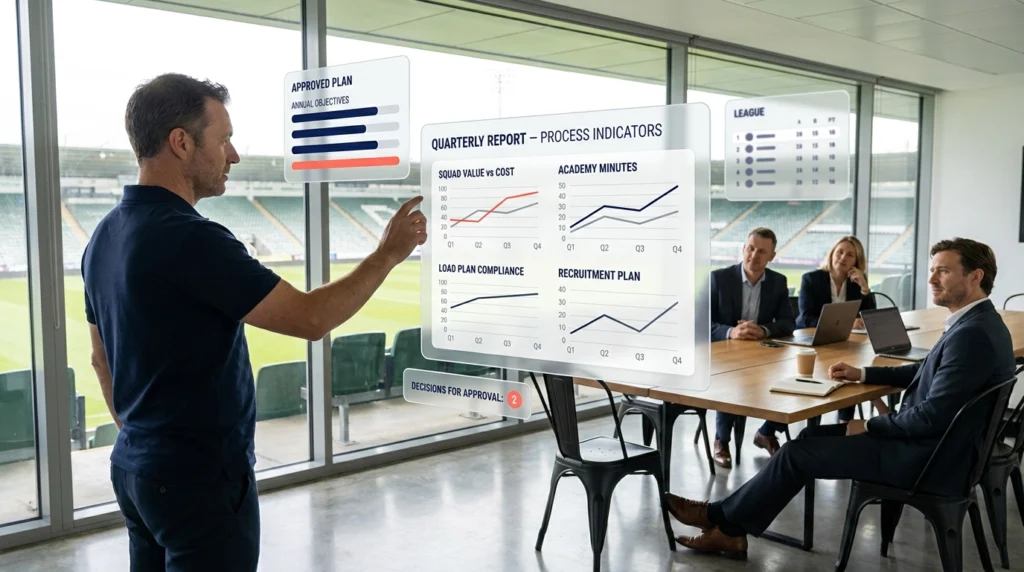
Process indicators are, for example, the evolution of squad value against its cost, academy players’ minutes in the first team, injury and load plan compliance against the previous season, the status of strategic renewals, or the degree of execution of the recruitment plan. They are measurable, attributable to the sporting department’s work, and they build a medium-term narrative that dampens short-term noise.
The structure of a good quarterly report
An effective quarterly report fits in a few pages and follows a stable structure, because format stability is what allows the board to compare quarter against quarter. A structure that works: first, the status of the approved plan, with each annual objective and its degree of progress. Second, the process indicators, always the same ones, with their historical series. Third, deviations and risks, told by the sporting director himself before someone else tells them. Fourth, decisions that require approval, with options and a recommendation. A report that only informs wastes the meeting; the goal is for the board to decide on what falls to it with the best possible information.
Data does not persuade on its own
A misunderstanding worth dismantling: bringing data into the boardroom does not win the argument by itself. A dashboard with forty metrics produces the same opacity as no data at all. Selection is the work. Three or four well-chosen indicators, sustained over time, with a definition the board understands and that does not change every quarter, are worth more than any deployment. And each figure needs its context: academy minutes matter because they reduce future squad cost and generate transfer value, not as a decorative number. The sporting director who explains why he measures what he measures is educating his board, and an educated board is the project’s best protection during bad runs.
Board reporting preparation starts long before the meeting
None of the above is viable if the data has to be manufactured the week before. If preparing the quarterly report requires chasing the medical department, reconstructing minutes by hand and requesting figures from three departments, reporting becomes a toll paid late and paid badly. The precondition is that the club’s operational information is recorded continuously and remains available for analysis. When that happens, the quarterly report is a view over data that already exists, not an archaeology project. The difference shows in the quality of the report and, above all, in the time the sporting director recovers for his real work.
Where to start with board reporting
If your board reporting today is reactive and irregular, the first decision is neither technological nor cosmetic: it is agreeing on the frame. Propose to your board an explicit agreement on three or four process indicators by which the sporting project will be evaluated, alongside results but not beneath them. Put it in writing and present them every quarter without exception, in good times and bad. That pact changes the underlying conversation: it turns the board into a partner in a measurable plan instead of a judge of the last matchday. The report format, the historical series and data automation can come later. The frame comes first.