
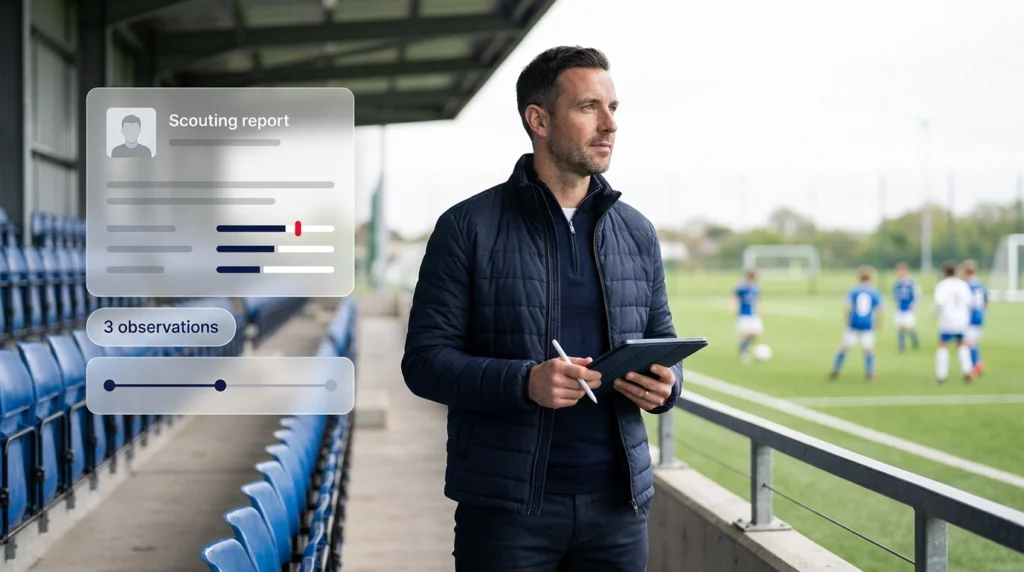
Scouting with your own data starts with an uncomfortable fact: at most clubs, the recruitment department’s most valuable asset is not on any server: it is in the heads of two or three veteran scouts. They know which full-back in the regional fourth tier can play out from the back, which youth player in the neighbouring province will develop late but well, which striker was discarded two years ago for reasons that no longer apply. That knowledge is real and enormously valuable. It also has a structural problem: it disappears when the scout leaves, falls out with the club or simply is not available on the day a decision must be made.
Scouting with your own data, which means building your own recruitment database, is not about replacing the scout’s eye with a spreadsheet. It is about ensuring that what the scout sees gets recorded, becomes searchable and accumulates over time. The eye remains the sensor. What changes is that the club stops depending on its memory.
The report that dies in a drawer
Almost every club produces scouting reports, but few practise scouting with their own data. The problem is what happens next. The report is sent by email, discussed in a meeting and filed in a folder nobody ever opens again. Six months later, another scout watches the same player and writes another report from scratch, unaware the previous one exists. The club pays twice for the same information and misses the most valuable thing: evolution. A player watched three times in eighteen months by different people is a time series, not three loose opinions. But it is only a series if the three reports live in the same place, linked to the same player, with comparable criteria.
The four components of scouting with your own data
An operational recruitment database has four components. The first is a single file per observed player: identifying data, known contractual situation, observation history and any relevant context. The second is a common report template: every scout rates the same areas on the same scale, which does not prevent qualitative nuance but does allow comparison. The third is a decision log: why a player was discarded, who discarded him and with what information, because a rejection from two years ago may have expired. The fourth is the link to the club’s needs: each squad position with its renewal or departure horizon, so that recruitment searches for what the club will need rather than whatever appears by chance.
External data yes, but as a filter, not a verdict
External data providers cover more leagues and divisions every year, and they are useful for what they are: filtering. They allow you to reduce a universe of thousands of players to a list of dozens that deserve in-person observation. What they cannot do is replace that observation, especially in youth football and lower divisions, where external data quality drops sharply and where, precisely, the market opportunities a mid-sized club can afford are found. A club’s competitive advantage will never lie in data anyone can buy. It will lie in scouting with your own data, a record accumulated over years of players the providers do not cover well.
The calendar favours whoever keeps records
There is a practical reason to organise recruitment now rather than in December. January shortlists are built between October and November. If scouting with your own data is up and running, preparing the winter window means filtering and prioritising what has already been observed. If it is not, it means improvising: urgent phone calls, express reports and decisions supported by a single viewing. The difference between the two situations is invisible in summer, when there are months ahead. It becomes visible in January, when there are days.
Where to start scouting with your own data
If your recruitment department runs today on memory and emails instead of scouting with your own data, the priority is not hiring more scouts or buying more data. It is to stop losing what it already produces. Start with two measures. First: a single file per observed player, however austere at the beginning, and an effective ban on reports that are not linked to it. Second: a common evaluation template, agreed with the scouts themselves so they feel ownership rather than imposition. With those two pieces working, every month of work accumulates instead of evaporating. The next layers, a rejection log and the link to squad planning, can come in a second phase. But the single player file cannot wait: every week without it means more reports dying in a drawer.