
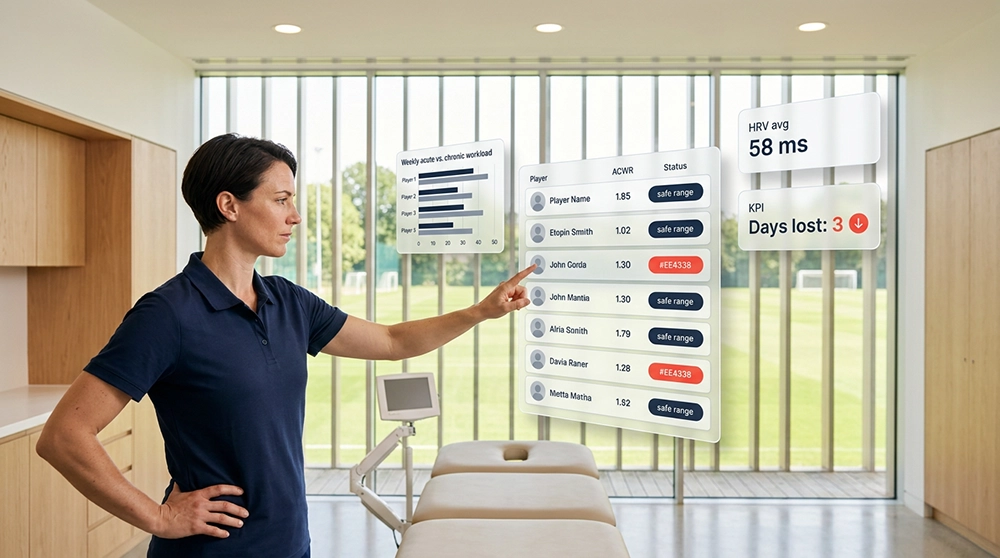
In professional football, injuries are rarely an accident. They are the visible end of an accumulation of signals the club has had for weeks without reading them together. Disproportionate training load, irregular sleep, rising subjective fatigue, a subtle drop in positional performance metrics, a stride asymmetry the physiotherapist noticed but no one revisited. When all those signals live in different systems, the club reacts; when they live together, the club anticipates. That gap between reacting and anticipating is the core of injury prevention in football, and what separates modern medical departments from traditional ones today.
The real cost of an injury in a football club
Injuries are one of the highest hidden costs in a professional club. The UEFA Elite Club Injury Study has been measuring the impact for over fifteen years: a professional player misses an average of 30 to 50 days of competition per season due to injury, and an elite club manages between 8 and 12 relevant muscle injuries per season. Howard Hamilton’s analysis for FC Business estimates that every day a professional player is sidelined costs the club between €5,000 and €30,000 in amortized salary, sporting impact and loss of market value.
Beyond the financial cost, the sporting impact is enormous. Teams with lower injury rates consistently finish higher in the table. Not because they are stronger, but because they can field their best players in the decisive matches and keep their playing model intact without improvised patches.
What load monitoring actually is, and why it’s not just gps
Load monitoring is not reading GPS data at the end of training. It’s a continuous process that combines external load (what the player does: distance, sprints, accelerations, high-intensity decisions) with internal load (what their body feels: heart rate, perceived exertion, recovery, sleep) and with each footballer’s individual response.
The most common mistake is working only with external load. Two players can complete the same session and have a radically different internal response. One finishes the week fresh; the other accumulates residual fatigue that doesn’t show in GPS data but does in their resting heart rate, their HRV and their subjective perception. If the club looks only at the external side, it won’t detect risk in the second player until injury strikes.
The indicators that actually predict injuries
The scientific literature on injury prevention in football, led by the work of Tim Gabbett, Martin Buchheit and the Aspetar group in Qatar— has consolidated a set of indicators that, read together, predict risk within a reasonable margin.
The acute:chronic workload ratio (ACWR) compares the last 7 days of load with the average load of the previous 4 weeks. Very low values (a deconditioned player) or very high values (a player ramping up too fast) are associated with higher injury incidence. It is not a crystal ball, but combined with medical data it is one of the strongest markers.
Neuromuscular asymmetry measured with weekly tests, jumps, isometric squats, force-velocity profiles— detects drops in musculoskeletal performance before the player reports pain.
HRV (heart rate variability) and daily subjective questionnaires (sleep, fatigue, stress, muscle soreness) capture the internal fatigue that neither GPS nor physical tests see.
A loaded, queryable medical history is the final major predictor. A player with a hamstring injured twice in the previous season is a different profile, and the prevention model needs to know it in every session, not discover it once damage is already done.
Why injury prevention fails: the siloed data problem
Almost every club already has the data it needs. The problem isn’t acquisition, it’s integration. The fitness coach has the GPS, the doctor has the medical history and test results, the physiotherapist has the treatment records, the sports psychologist has the wellbeing questionnaires, the head coach has the minutes. Each person looks at their own piece. Rarely does anyone look at the whole.
When a player gets injured, the post-incident audit almost always reveals the same story: the signals were there. The load was accelerated, subjective perception had dropped, the latest test showed asymmetry, and the player had a relevant history. The information existed. It just wasn’t on the same screen, at the same moment, for the person making the decision.
This is where modern football injury prevention is played out: not in buying more sensors, but in building an information flow that allows the medical staff, the fitness coach and the head coach to make decisions with the same picture in mind.
How to structure an integrated injury prevention model
Clubs that sustain low injury rates work with a prevention model that shares several traits:
- A single repository where external load, internal load, medical data and history coexist. Without that unification, prevention is opinion.
- Daily review rituals where the doctor, fitness coach and head coach share a common screen before locking the day’s session.
- Automatic per-player alerts when a set of indicators crosses a risk threshold defined by the coaching staff, not by a vendor.
- Individualized protocols: two players at the same threshold may need different responses depending on their history and profile.
- Weekly model review: no threshold is universal, and the clubs that prevent best continuously tune their rules based on what they see in their own squad.
The case of youth football and the academy
Load monitoring isn’t only for the first team. The academy concentrates a different kind of risk: growing players, dense competition calendars, dual commitments with national teams and a fixture volume that often exceeds the first team’s. FIFA has flagged “youth player overload” as a growing concern, and clubs with strong academies, Ajax, Sporting CP, Athletic Club, Real Madrid— increasingly extend their injury prevention models into the lower categories.
The added challenge is that academy data is more scattered: reserve teams with their own staff, youth squads with rotating coaches, players who only sometimes train with the first team. If the club’s load system doesn’t follow the player up and down, prevention breaks at the transition. Longitudinal traceability of the young player is, today, one of the highest-return areas in professional clubs.
From model to operations: where to start
Implementing an integrated injury prevention model doesn’t require buying new technology. Most professional clubs already have 80% of the data. The usual path is:
- Audit what is being measured, who measures it and where it is stored. Duplications and gaps tend to surface.
- Unify the information in a system accessible to the doctor, fitness coach and head coach, with role-based permissions.
- Agree thresholds and alerts with the technical staff, not impose them. If the fitness coach hasn’t signed off on the model, it won’t be applied.
- Measure the impact: days lost, injuries per thousand hours of exposure, recurrence rate. Without measurement there is no improvement.
At Director11 we work specifically on this link: integrating what the club already has into a single platform, so that prevention stops depending on chance coordination between departments and becomes an operational process.
Frequently asked questions about load monitoring and injury prevention
Is GPS enough to monitor load?
No. GPS measures external load, but the player’s response depends on internal load (HRV, sleep, subjective fatigue) and on their medical history. Without integrating these dimensions, the reading is partial and injury risk remains high.
Which prevention KPIs should a professional club track?
The most widely used are days lost per season, injuries per thousand hours of exposure (training and competition separated), recurrence rate, per-player ACWR and the percentage of sessions modified by alert. Cross-referenced, they provide a reliable picture of the prevention model’s state.
Is this model applicable to smaller or academy clubs?
Yes, adjusting investment and sophistication. Many development clubs can start with daily subjective questionnaires, competitive minutes monitoring and a structured medical history record. The qualitative leap doesn’t require expensive technology, it requires process discipline and connected data.
At Director11 we help football clubs integrate training load, medical data and player history on a single platform, so injury prevention moves from being an individual effort to being a structured process. If you want to see how it would fit in your club, we can have a first conversation with no commitment.