
Long-term sports planning is rarely found. In professional football, everything pushes toward short-termism. Results pressure, coaching cycles, management turnover, the media weight of every defeat and market logic turn the medium term into a luxury. Yet, the clubs that consistently compete above their budget share one trait: they plan at three, five, and sometimes ten years, even when coaches, owners or economic contexts change. Long-term sports planning isn’t a strategic document archived in a drawer: it’s a decision-making system that protects the club from its own urgencies.
THE HIDDEN COST OF SHORT-TERMISM IN FOOTBALL
When a club only plans for the season, every important decision —a signing, a renewal, a coaching change— is taken under the pressure of immediate results. The outcome is well known: late and expensive signings, contracts signed to avoid relegation or force promotion, and playing-model changes each time a new coach arrives.
The financial impact is direct. Deloitte’s “Annual Review of Football Finance” estimates that clubs with high turnover in sporting direction and coaching have squad costs between 15% and 25% higher than equivalent clubs with greater stability. Not because they pay more, but because they buy worse and sell worse. Ajax, Benfica, Atalanta or Brighton are classic examples of the opposite thesis: continuity of model allows optimized buying, selling and internal development over the years.
WHAT A LONG-TERM SPORTS PLANNING ACTUALLY IS
A long-term sporting plannning is not an 80-page document that is signed and filed away. It’s a living framework that connects four layers: the club’s identity (who we are and who we want to be), the sporting model (how we want to compete and develop), the economic model (what budget and what risk we assume) and the organizational structure (who decides what and with what information).
When these four layers are aligned and made explicit, the club gains a capability that is hard to see from the outside: making coherent decisions even as the people change. A signing isn’t evaluated only on “fitting the current coach”, but on fitting the model. A renewal isn’t decided only by immediate performance, but by fit within the three-year project. A sale isn’t closed only on the offer received, but on its impact on the plan.
THE THREE PLANNING HORIZONS
Clubs that operate with a project vision work simultaneously on three time horizons, each reviewed at a different cadence.
The tactical horizon (current season) absorbs almost all public attention: lineups, competitions, transfer market. But it should not be the framework from which structural decisions are taken. It is the execution horizon, not the design one.
The strategic horizon (2–3 years) is where the decisions that most impact competitiveness are played: squad structure by age and contract expiry, planning of the academy-to-first-team bridge, investments in infrastructure and data, and multi-year commitments with key staff.
The project horizon (5–10 years) defines identity and sustainability. What kind of club we want to be, what player profile we want to develop, what medical and technological infrastructure we will have, how our economic model behaves across success and failure cycles. It is the horizon where it is decided whether the club will be big or small within its context.
OBJECTIVES, KPIs AND PLAN GOVERNANCE
A plan without measurable objectives is a statement of intent. The sporting plan’s objectives must be specific by horizon and connect sporting and financial dimensions:
- Sporting objectives: target competitive ranking, progression in competitions, percentage of academy players in the first team, average integration time from the reserve team.
- Economic objectives: wage bill to revenue ratio, weight of ordinary income vs. player sales, annual squad amortization, capacity to generate operating cash.
- Structural objectives: stability of key staff, process implementation, quality of data available for decision-making.
Each objective needs an owner, a tracking KPI and a review ritual. Monthly sporting committees, quarterly management reviews and annual audits are not bureaucracy: they are the infrastructure that prevents the plan from evaporating at the first defeat.
SQUAD AND ACADEMY PLANNING: THE CLEAREST EXAMPLE
The area where long-term sports planning becomes visible first is squad management. A club with real planning builds a “squad matrix” that cross-references positions, ages, contract expiries, market value and projection. That matrix lets you see, two years in advance, the gaps that are coming, the key players at risk of being lost and the academy graduates who should have a pathway.
Real Madrid, Ajax and Villarreal are public examples of this logic: signing, renewal and internal promotion decisions are made against that matrix, not against the gut feeling of the month. When this discipline is lost, the squad ages without orderly renewal, contracts expire in blocks, and the club’s bargaining power weakens.
TECHNOLOGY AND DATA: THE INVISIBLE BACKBONE OF PLANNING
Long-term planning requires a technical backbone that many sporting organizations still lack. It is not enough to have one spreadsheet with contracts and another with scouting reports. The plan only lives if data is integrated: performance, health, contracts, scouting, finance and competition must be readable together.
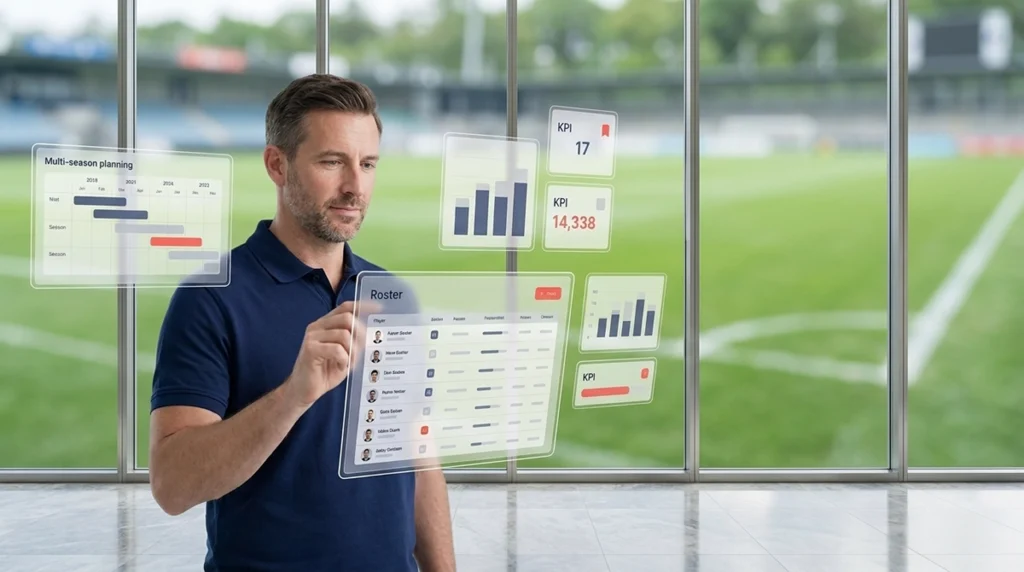
When a sporting director can open a single screen and see —in one place— the current squad, the projected squad two years out, contract expiries, internal and external candidates by position and the financial impact of each decision, the plan stops being a document and becomes a tool. This integration is, precisely, the work Director11 does with professional clubs: not replacing existing platforms, but connecting them so that planning becomes operational.
HOW TO START IF THE CLUB HAS NO PLAN YET
Most clubs that begin a long-term planning process do so after a crisis: a relegation, a change of ownership, a breakdown with a key coach. It is the worst possible moment and, still, the one that usually triggers action. Some practical steps work better than others:
- Start by auditing what information already exists, rather than buying new platforms. Most data is already in the club, just not connected.
- Make identity and model explicit before writing the plan. Without agreement on what club we want to be, any plan is unstable.
- Design the plan with the people who will execute it, not just with top management. A plan not signed by the sporting director, the head of academy and the CFO won’t be applied.
- Review the plan quarterly with data, not each time there is a crisis. Review discipline protects the plan more than the quality of the initial document.
FREQUENTLY ASKED QUESTIONS ABOUT LONG-TERM SPORTS PLANNING
How long should a sporting plan cover?
The common practice in European professional clubs is to combine a tactical horizon (1 year), a strategic one (3 years) and a project horizon (5–10 years). The three are updated at different cadences but coexist.
What happens to the plan if the coach or sporting director changes?
That is precisely the plan’s value: it must survive changes. If a plan collapses with every transition, the problem isn’t the transition —it’s that the plan wasn’t institutionalized. Sustainable clubs separate the plan (owned by the club) from its execution (responsibility of the current technical team).
Is long-term planning possible without significant resources?
Yes. Planning is more a discipline than an investment. Clubs with modest budgets —Brighton, Union Berlin or Girona at their peak— have shown that the differentiator is not the department’s size, but the clarity of the model and the consistency of its application.
At Director11 we support clubs in building and operating medium and long-term sporting plans, integrating squad, academy, performance and finance data on a single platform. If you want to explore how it would apply to your club, we can have a first conversation with no commitment.
director11.com