
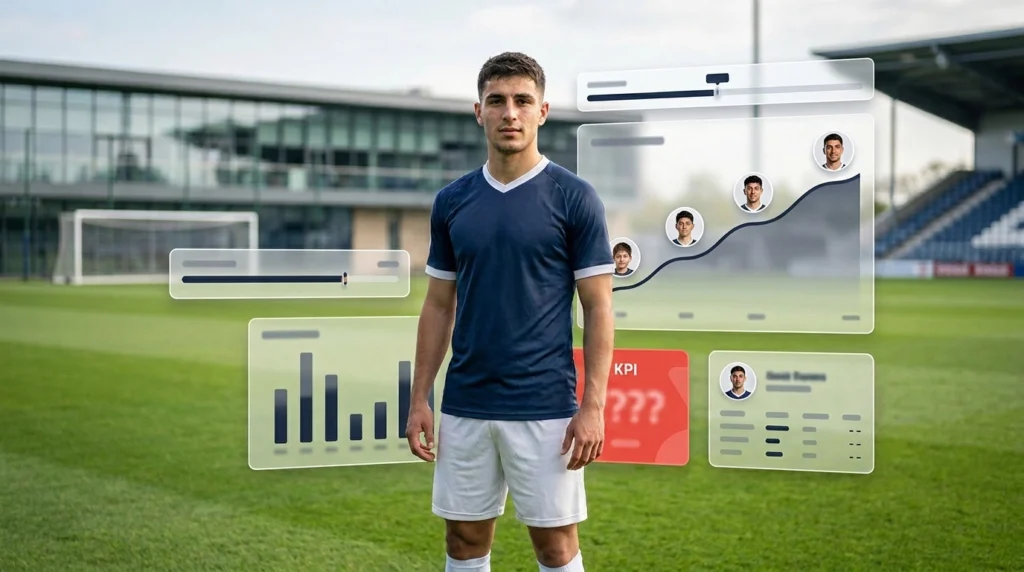
For years, tracking a player meant looking at minutes played and the occasional medical note. That model no longer holds up. The clubs setting themselves apart today, from the first team down to the youth categories, build an integral profile for each player, combining sporting, physical, medical, psychological and even academic data. The logic is simple: every player develops at a different pace, and treating them as part of a general average is the fastest way to lose talent along the way.
1. From isolated data to the 360° player profile
The clearest trend is moving away from looking at performance in separate silos. The most advanced tracking systems integrate technical, physical, medical, psychological and academic information into a single profile, designed to support individualized plans and coordinated decisions across the whole coaching staff. This changes the question a coach asks. It’s no longer just “how did they perform in the match”, but “how is this person developing across every dimension that shapes their growth as a footballer”.
In practice, this means a fitness coach, a club psychologist and the age-group coach are working from the same file, not from three separate records that never cross paths.
2. GPS and physical load: personalized tracking from a young age
GPS technology, already standard in professional football, enables something crucial at academy level: adapting training plans to each player’s physical and technical needs instead of applying the same workload to an entire group. Tracking workload helps fitness coaches spot signs of fatigue or overload before they turn into an injury, which matters even more with young players whose physical development is still underway. La Masia, FC Barcelona’s academy, is one of the most cited examples of this: from a young age, players use monitoring technology to measure their physical and technical performance as a natural part of their development.
3. Individual video analysis: correcting the person, not just the team
Video analysis has stopped being a tool reserved for preparing the next match. Today it’s used to isolate a specific player’s contribution within a full session, generate visual reports on their decision-making, and show them the correction directly. For a young academy player, seeing their own action flagged on video is usually far more effective than a verbal explanation, especially at ages where visual learning tends to outweigh conceptual learning.
4. Individualized plans: the model behind the top academies
Clubs like Real Madrid build academy tracking around individualized training and development plans, defined according to each player’s needs and potential, with coaches, technical staff and psychologists working in coordination. Attention isn’t limited to the physical and technical side either. It includes academic and psychological support, because the goal isn’t only to develop a footballer, but to support a person through a long and demanding process.
This approach also pushes coaching staff to assess each player based on position, biological maturity, cognitive profile and projection within the club’s playing model, not just chronological age. Two players in the same age group can be at completely different stages of development.
5. The academy-to-first-team transition: the most fragile point in the process
All of this individualized tracking exists for one final purpose: preparing the jump to the first team. That jump is planned from the youth categories onward, gradually bringing standout players into training sessions and matches with the senior squad so they can adapt to its pace and playing style before their official debut. It’s also the point where the most talent gets lost if tracking hasn’t been consistent. A player with well-documented physical, technical and psychological data arrives at that transition with far more information available to the coaching staff than one who was only assessed sporadically.
6. The challenges that shape everything above
Individualized tracking sounds good in theory, but it runs into very concrete structural problems:
- Staff turnover and lost history. When a coach, fitness trainer or analyst changes, much of a player’s history disappears if it isn’t centralized in a system and instead depends on the memory of whoever is leaving.
- Resource inequality between the first team and the academy. Professional football usually has budgets far larger than the youth divisions, which leaves academy tracking as a secondary concern at clubs that don’t prioritize long-term sustainability.
- The real odds of reaching the elite are low. In Spain, only about one in every 2,600 registered youth players ever makes a First
Division debut, which means individualized tracking needs to be thought of as a tool for holistic development, not just a talent-selection filter.
What a club should prioritize in individualized tracking
My recommendation is to centralize information before adding more sensors or more software. There’s little point having top-tier GPS at academy level if a player’s physical data lives in one spreadsheet, the medical data in another, and the psychological notes in the head of a single person who could leave the club tomorrow. A centralized system, even a simple one, that follows the player from one age group to the next is what actually sustains individualized tracking over time. Only once that foundation is in place does it make sense to invest in more sophisticated video analysis or predictive models of physical development, because those tools only add value when they’re fed by a continuous player history, not scattered measurements.
The end goal doesn’t change: the more consistent data that follows a player from the academy to the first team, the more real information the coaching staff has for the hardest decision of all, whether to trust them with a place in the senior squad.
*Note: some figures in this article (such as the share of academy players who make a First Division debut) come from industry studies and reports, and should be read as directional references rather than universal statistics applicable to any league or country.