
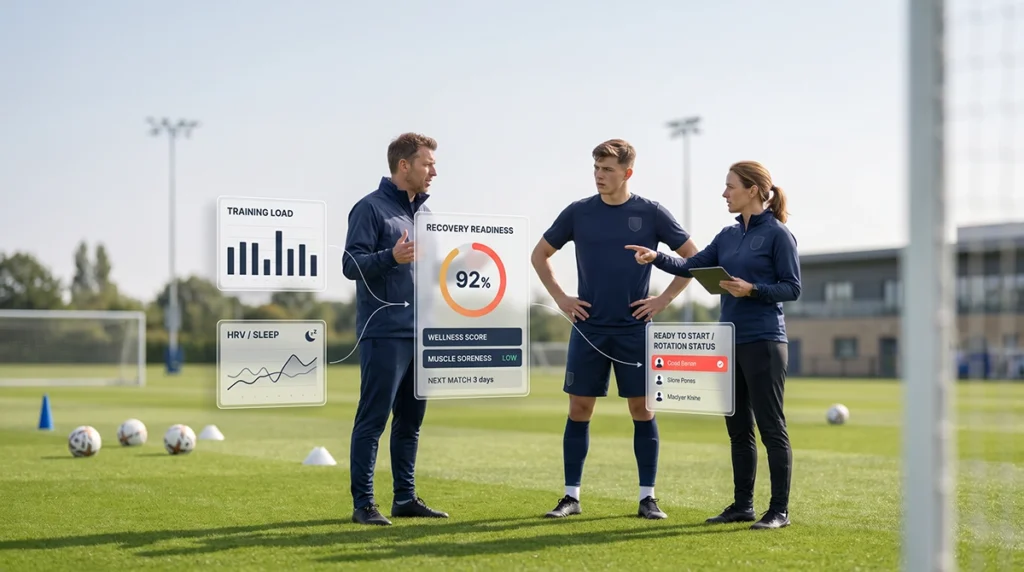
In elite football, almost nobody argues about how to train harder anymore. The question that decides seasons is a different one: how to get the player to the next match fully recovered. With calendars of fifty or sixty matches, international breaks and weeks with three fixtures, recovery has stopped being a detail handled by the medical staff and become a measurable competitive advantage. Optimizing football player recovery rarely comes down to physiotherapy equipment, but to whether training data and health data are read together or in isolation: that’s the difference between the clubs that master it and those that improvise it.
Why Football Player Recovery Is Now a Competitive Advantage
Fixture density keeps growing. The UEFA Elite Club Injury Study has shown for years that the highest incidence of muscle injuries concentrates in congested calendar stretches, when players accumulate matches with fewer than five days between them. The body doesn’t break from training a lot, it breaks from not recovering enough between efforts.
The cost is twofold.
First, performance: a player who enters a match with incomplete recovery runs less in the final twenty minutes, makes worse decisions and raises their injury risk.
Second, the financial cost of that injury, which several industry analyses place between €5,000 and €30,000 per day sidelined in amortized salary, sporting impact and loss of market value.
Optimizing football player recovery isn’t a luxury for the elite end of the game; it’s the highest-return lever a professional club has today.
Recovery Is Not Rest: What We Actually Measure
The starting mistake is treating recovery as a synonym for rest. Recovery is a physiological process with several layers, and each one is measured differently.
There is neuromuscular recovery (the muscle’s ability to produce explosive force again), metabolic and inflammatory recovery (how the body responds to the tissue damage of effort), autonomic recovery (the balance of the nervous system, read well through heart rate variability) and perceived recovery, which is what the player feels in sleep, fatigue and mood.
Two players who did the same session and slept the same hours can be in opposite recovery states. One is ready to repeat high intensity in forty-eight hours, the other needs seventy-two.
If the club applies the same protocol to both, it is hurting one of them. Well-managed recovery is, above all, individual.
The Data That Measures Real Recovery
The good news is that recovery leaves measurable traces. The ones that work best, when read together, are these:
- Heart rate variability (HRV) and resting heart rate are today the most reliable markers of the autonomic nervous system’s state. A depressed HRV over several consecutive days indicates the player is not absorbing the load, even if they feel fine.
- Sleep, in both duration and quality, is the most powerful recovery tool that exists and the cheapest. Measuring real hours slept, latency and awakenings adds more than almost any expensive recovery device.
- Short neuromuscular tests, such as the countermovement jump, detect drops in force production before the player reports tiredness. It is the most direct indicator of whether the legs have come back.
- Daily subjective wellness questionnaires (sleep, fatigue, muscle soreness, stress) capture information no sensor sees and, used well, are among the most solid predictors of a player’s state.
And underneath everything, accumulated training and competition load, because recovery only makes sense when read against the effort that caused it. The same HRV figure means different things after an easy week or after three matches in seven days.
Why Recovery Fails: Training And Health In Separate Systems
Almost every club already collects this data. The problem, just as with injury prevention, is not measurement but integration. The fitness coach has the load and the neuromuscular tests, the medical department has the physiological markers and the history, the wellbeing lead has the questionnaires and the sleep, and the head coach has the minutes and the fixture plan.
Each one manages their own piece and almost nobody sees the full picture.
The result is that recovery decisions are made on partial information. A rest day is planned for the whole squad when only half of it needs one, or high intensity is demanded of a player whose HRV has been on the floor for three days because whoever runs the session doesn’t have that data in front of them.
Recovery breaks in the gaps between departments, not from a lack of knowledge.
This is the real leap: not buying another bioimpedance scale or another wearable, but getting training load, medical data and wellbeing onto the same screen, at the same moment, for whoever decides the next day’s session.
How To Build An Integrated Recovery Model
Clubs that recover well share a model with recognizable traits:
- A single repository where load, HRV, sleep, neuromuscular tests, questionnaires and medical history all live together. That unification depends on choosing the right club management software, because without a platform that centralizes this data, recovery decisions are pure guesswork.
- A daily per-player readiness reading, a kind of availability traffic light, that the doctor, the fitness coach and the head coach look at before locking the session.
- Individualized recovery protocols rather than squad-wide ones: active strategies, deloading, targeted sleep or regenerative work depending on what each player and their history demand.
- Automatic alerts when several of a player’s indicators point to incomplete recovery, defined by the coaching staff and not by a vendor.
- Periodic model review, because no threshold is universal and the best clubs tune their rules based on how their own squad responds.
Recovery In Congested Calendars And On The Road
Integrated recovery makes the biggest difference in three-match weeks and on long away trips. In those stretches there is no time to train hard, so all the performance gain is decided by managing the hours between matches well: prioritizing sleep over travel, adjusting nutrition to the regeneration window, and deciding who starts and who rotates based on real recovery state rather than just the ideal eleven.
A club that reads this data together can make rotation decisions backed by evidence: this player has recovered and starts again, this one hasn’t and rests or plays fewer minutes.
Without that integrated picture, rotation is a bet, and bets in a congested calendar are paid for with muscle injuries in the seventieth minute.
Recovery In The Academy And The Developing Player
In the youth categories, recovery is if anything more critical and more neglected. The young player is growing, competes for their club and sometimes for the national team, strings together matches without the first team’s recovery structure and rarely has longitudinal tracking of their state.
FIFA has warned about youth player overload, and teaching an academy footballer to sleep, eat and read their own fatigue is a long-term performance investment.
The added challenge is scattered data: reserve teams with their own staff, youth squads with rotating coaches, players who move up and down from the first team.
If the recovery system doesn’t follow the player through those transitions, the most valuable information is lost: how a body that is still developing actually recovers.
From Model To Operations: Where To Start
Setting up an integrated recovery model doesn’t require new technology. Most professional clubs already have a good share of the data. The usual path is:
- Audit what is measured about recovery today, who measures it and where it is stored. Duplications and gaps almost always surface.
- Unify load, medical data and wellbeing in a system accessible to the doctor, fitness coach and head coach, with role-based permissions.
- Agree the readiness traffic light and the alerts with the technical staff instead of imposing them. If the fitness coach hasn’t signed off on the model, it won’t be used.
- Measure the impact: quality minutes available, sessions modified by recovery state, injuries in congested stretches and recurrences. Without measurement there is no improvement.
At Director11 we work specifically on this link: integrating what the club already has into a single platform, so recovery stops depending on departments happening to coordinate and becomes an operational, traceable process.
Frequently Asked Questions About Football Player Recovery
- What is the best indicator to know whether a player has recovered?
There isn’t a single one. The most reliable combination cross-references heart rate variability, sleep quality, a short neuromuscular test and the subjective questionnaire, always read against accumulated load. A single isolated figure is misleading.
- Are recovery wearables and rings useful for a professional club?
As a source of sleep and HRV they can help, but their value depends entirely on integrating that data with training load and medical history. A device that lives in a separate app, disconnected from the rest, adds noise rather than decisions.
- Is this model applicable to smaller or academy clubs?
Yes, adjusting the investment. Many clubs can start with daily wellness questionnaires, sleep tracking and minutes monitoring, connected in one place. The leap doesn’t require expensive technology, it requires process discipline and connected data.
At Director11 we help football clubs integrate training load, medical data and player wellbeing on a single platform, so that football player recovery stops being a scattered effort and becomes a structured process that protects performance at the key moments of the season.
If you want to see how it would fit in your club, we can have a first conversation with no commitment.