
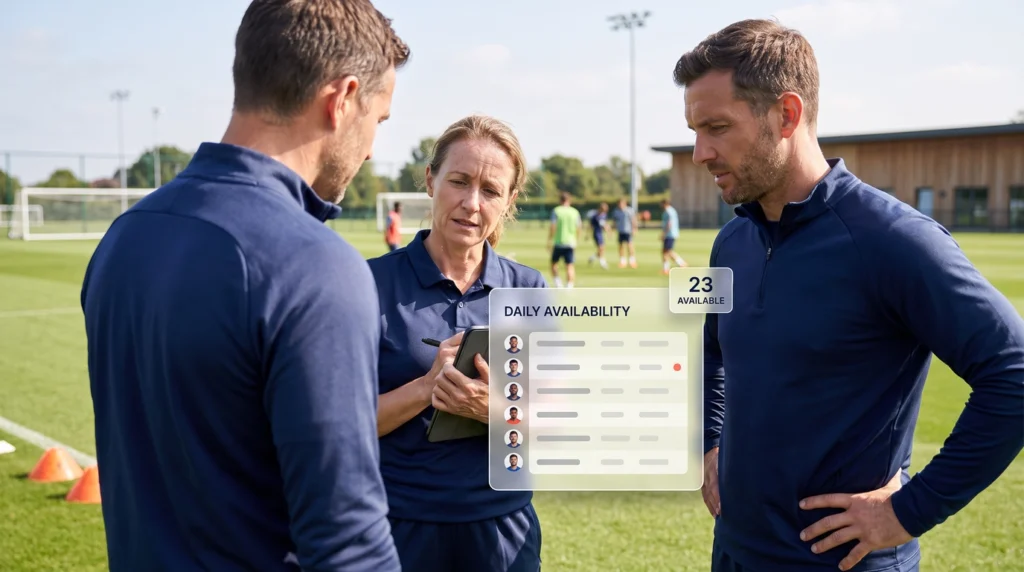
The season is underway, and with it returns a problem that almost no club has fully solved, coordination between departments: the coaching staff, the medical department and the sporting director all work with the same group of players but with different information. The head coach plans the week without knowing that the rehab specialist has pulled a player back. The doctor learns from the press that a player carrying discomfort is about to play ninety minutes. The sporting director hears about a relapse after having already committed to an answer in front of the board. None of these failures is one person’s fault. They are circuit failures.
During preseason these misalignments are tolerated because there is time to fix them. In the middle of competition there is not. Every week brings a match, sometimes two, and decisions on load, squad lists and availability are made in hours. If information travels by WhatsApp, hallway conversation or a phone call someone forgets to return, the club is deciding with incomplete data at the exact moment it needs precision most.
The three classic silos and what they cost
The first silo is the sporting one. The coaching staff accumulates training, load and performance data in their own spreadsheets or in analysis software only they operate. The second is medical. Records, treatments and recovery timelines live in the medical department’s folders, sometimes on paper, almost always out of everyone else’s reach. The third is managerial. Contracts, registrations, federation status and squad planning sit with the technical secretary and the sporting director.
Each silo works reasonably well internally. The cost appears at the seams, and in elite football it has been measured. A player carrying discomfort trains at full load because the fitness coach never saw the medical report. An academy player joins first-team training without anyone checking his accumulated weekly load with the reserves. A sporting director negotiates a loan without the player’s complete injury picture. These are good-faith decisions made with half the information.
Why meetings are not enough
The usual answer to this problem is more meetings. Monday meeting to review the weekend, Thursday meeting to prepare the match. Meetings are necessary, but as an information transmission system they have two serious defects. The first is latency: what happens on Tuesday afternoon is not communicated until Thursday. The second is volatility: what is said in a meeting is not recorded anywhere consultable, and whoever was absent depends on someone remembering to fill them in.
Meetings are for deciding, not for informing. When a club uses meetings as its main information channel, it turns them into catch-up sessions that consume the time that should be spent deciding. The underlying information should be available before anyone sits down, not distributed at the table.
What well-built coordination between departments looks like
Healthy coordination between departments in mid-season has three characteristics. First: every data point is recorded once, at the moment it is produced and by the person who produces it. The physio logs the treatment when it ends, the fitness coach uploads the load when the session finishes, the technical secretary updates the contractual status when the signature happens. Nobody transcribes, nobody duplicates.
Second: each role sees what it needs without asking. The head coach checks the squad’s real availability on Monday morning without calling anyone. The doctor sees the week’s load plan before authorising a return. The sporting director reviews a player’s complete status before a market conversation. Information flows by default, not on demand.
Third: alerts replace manual vigilance. If a player exceeds a load threshold, if a recovery deadline arrives, if a registration expires, the system notifies whoever is responsible. Nobody has to remember to look.
The real obstacle to coordination between departments is not technological
Building coordination between departments requires less technology than it seems and more discipline than anyone admits. The usual obstacle is cultural: each department feels its data is its own and that sharing it means losing control or inviting interference. The doctor fears the coach will pressure recovery timelines. The coach fears management will question his training loads. These are legitimate fears, and they are solved with well-defined permissions, not with opacity. Sharing information does not mean everyone sees everything. It means each role sees what it needs to decide well, and that a common record exists to prevent contradictory versions.
Where to start
If your club is in mid-season and the silos are already costing you decisions, do not try to redesign all coordination between departments at once. Start at the point of highest risk: player availability. Establish a single daily availability report, fed by the medical department and the coaching staff, visible to the sporting director, and make it the only valid source for squad selection and planning. It is a contained change, it can be implemented in weeks, and it attacks the most expensive error directly: fielding or loading a player who should not have played. Once that report works and everyone trusts it, extending the same principle to loads, medical records and contracts will be a natural consequence, not a new battle.