
The winter transfer window has a bad reputation, and it has partly earned it. It is short, it is expensive and it is full of decisions made under pressure: a club in the relegation zone that needs a striker now, a bruised dressing room asking for reinforcements, a serious injury opening an unforeseen hole. But two things that tend to get confused should be separated. The January market does not punish those who sign in January; it punishes those who start thinking in January. Winter signings that work are decided, almost always, between October and November.
The reason is purely operational. A reasoned signing needs a complete chain: detecting the need, defining the profile, generating candidates, observing them several times, verifying their contractual and physical situation, negotiating and executing. That chain consumes weeks at best. If it starts on January 2nd, something will be skipped, and what gets skipped is usually repeated observation or verification, which are precisely the links that prevent expensive mistakes.
Winter transfer window: November is the month of decisions, not December
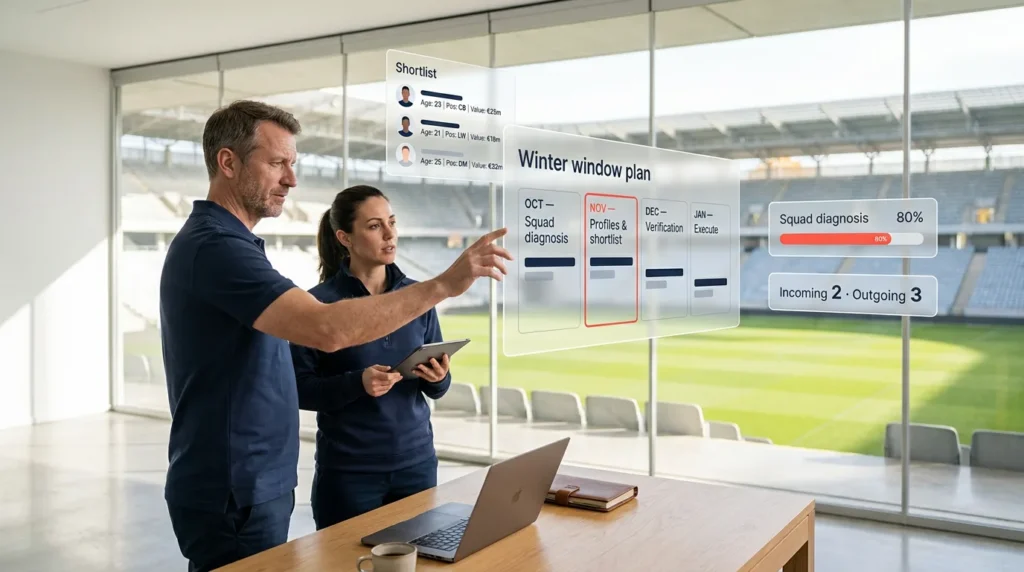
To reach January with the full chain covered, the internal calendar should look roughly like this. In October, an honest squad diagnosis: which positions are performing below plan, which players are accumulating worrying physical signals, which contracts and clauses condition movements. In November, profile decisions and shortlists: exactly what is being sought, with what budget, and three to five candidates per need, already observed or under observation. In December, verification and negotiation preparation, so that on January 1st the club executes rather than explores.
This calendar has an uncomfortable requirement: it forces you to evaluate the squad with data while the season is still in progress and conclusions are provisional. It is an exercise in internal honesty. Clubs that avoid it, waiting for the table to confirm what the data already suggests, pay for the wait in price and in the quality of the remaining alternatives.
The internal diagnosis matters more than the external market
The most neglected part of winter transfer window planning is not the list of targets, it is the club’s own diagnosis. Signing is the most expensive answer to a squad problem, and it only makes sense once the cheaper answers have been ruled out with data. Before defining an external profile, three questions. First, whether a position’s underperformance is structural or circumstantial, because a one-month slump does not justify a transfer. Second, whether there is an internal solution, an academy player who is ready or an underused squad member whose profile fits. Third, whether the problem is availability rather than level, because recurring injuries call for a different answer than poor performance.
Answering those questions well requires data series, not impressions: minutes and performance by position, loads and availability, the progression of reserve-team prospects. The club that has this information consolidated completes the diagnosis in days. The club that does not, debates opinions.
January is also an exit window
Planning winter only as a buying market leaves half the work undone. January is the season’s last chance to move on players without minutes whose contracts weigh on the budget, to loan out academy players who need competition, and to anticipate the sale of a footballer who is not going to renew. These outgoing operations require the same preparation as incoming ones: knowing which clubs are looking for that profile, having the player’s file presentable and having spoken with the footballer in good time. A player placed well in January frees up wage bill, avoids six months of deterioration and sometimes finances the reinforcement the squad needs.
Where to start preparing the winter transfer window
If your club has not yet started preparing for January, the absolute priority is the internal squad diagnosis, and it should be closed before mid-November. Gather in a single document the performance by position, accumulated physical availability, the contractual situation of the entire squad and the internal options in the reserve team. From that document come the two lists that govern the winter transfer window: real incoming needs and outgoing candidates. Only then does it make sense to look outward. A target list built without your own diagnosis is the classic recipe for the panic signing, and the panic signing is the most expensive one of the year.