
The summer window has just closed and most professional clubs now have between three and ten players competing in another shirt. They are club assets: footballers under contract, with market value and with a career plan that in theory justifies the loan. And yet, at many clubs, managing loaned players amounts to watching the match summary on Monday and the occasional call to the agent. The loan, which should be a development tool, becomes an information blackout that lasts a season.
The cost of that vacuum is paid in June. The player returns and the club must decide whether to integrate him, sell him or loan him out again, but it decides without data: no contextualised minutes, no documented physical evolution, no idea whether he played in his position or patched up another one, no updated medical history. The most important decision about the asset is made at the moment of greatest ignorance about it.
What real tracking means when managing loaned players
Watching the matches is not tracking. It is the most visible part and probably the least informative. Serious tracking of a loaned player covers four dimensions. The sporting one: minutes, actual position occupied, role in the team, performance evolution with metrics comparable to those the club uses internally. The physical one: training loads, fitness status, comparison against the values the player had when he left. The medical one: any injury, treatment or discomfort, communicated as it happens and not discovered upon return. And the personal one: adaptation to the city, the dressing room, the language where relevant, because a loan that works on the pitch can fail on the human side and vice versa.
The mistake of delegating tracking to the host club
Many loan agreements include information clauses: the host club commits to sharing medical and performance data. In practice, these clauses are fulfilled late, incompletely or only when something goes wrong. It is not bad faith, it is a matter of incentives. The host club manages the player for its own season objectives, not for the parent club’s career plan. Expecting it to prioritise outbound reporting is expecting too much.
The consequence is clear: when managing loaned players, tracking responsibility cannot be outsourced. The parent club needs its own circuit, with one person responsible for each loanee, a contact frequency agreed with the player and a centralised record where all the information accumulates season after season. If the data depends on the host club’s goodwill, there is no system, there is luck.
The player as the primary source
The most underused source of information when managing loaned players is the player himself. A loaned footballer, especially a young one, usually experiences the loan as a mixture of opportunity and abandonment. The club that maintains structured contact with him achieves two things at once: first-hand information on loads, discomforts and context, and an unmistakable message that the club still counts on him. A monthly video call with the tracking lead, a direct channel to report physical issues and a short questionnaire after each match cost little and yield a lot. The player who feels watched behaves like a professional in development. The one who feels forgotten does not always.
Integrating the loan into the club’s traceability
A loan is not a parenthesis in the player’s career, it is a chapter. If the club keeps a single file per footballer, with his sporting, physical and medical history from the academy onwards, the loan season must feed into that same file with the same data structure. Only then is the returning player comparable with the one who left, and only then are June’s decisions supported by a continuous series rather than two isolated snapshots. Clubs that already work on internal traceability have half the road covered: managing loaned players is a matter of extending the same file beyond their own facilities.
Where to start when managing loaned players
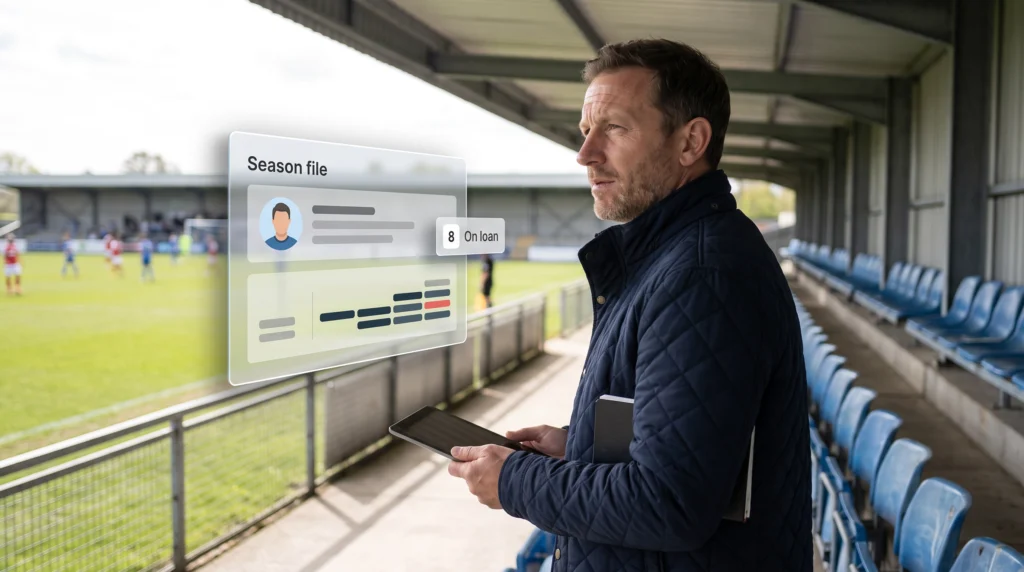
If your club has players out on loan right now and the tracking is informal, the priority is not negotiating better clauses for next year, it is regaining control of this season. Do three things this month. First, assign an internal lead for each loaned player, by name. Second, establish direct monthly contact with each player and record it in writing. Third, open a season file per loanee where everything accumulates: minutes, position, physical incidents and observations. With that, June’s decision will no longer be made blind. Contractual information clauses can wait for the next window; your own record cannot.